
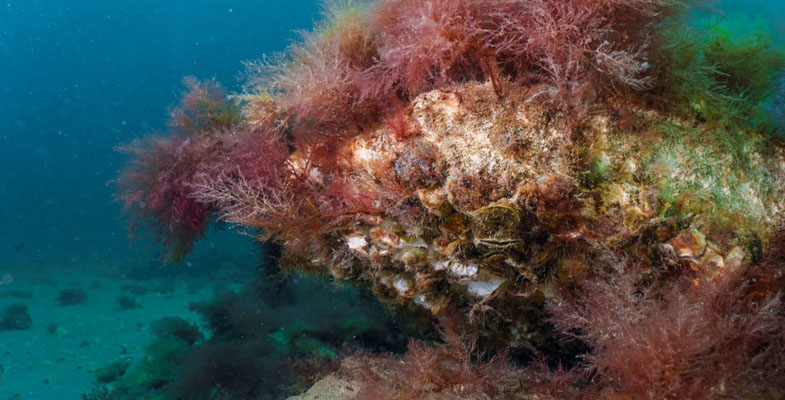
The music was great, but WOMADelaide also features an information series called The Planet Talks, with presentations on environmental, sociological and political themes. This year's included a session called Oceans Calling and featured a talk highlighting the size, scale and demise of the Southern Australian oyster reefs. These reefs once fringed Australia’s southern coastlines on a scale that rivalled the Great Barrier Reef, but today only roughly 8% of them survive due to excessive harvesting, trawling and dredging, including for building materials and cement. Speaker Dominic McAfee of Adelaide University highlighted the mind blowing scale of the reefs and their loss, and spoke also about restoration projects.
The SA algal bloom
What has been called an algal bloom is actually of the dinoflagellate species Karenia cristata. Dinoflagellate plankton are protists, that is a broad group neither plants nor animals but somewhere in between. Some can photosynthesise like plants, while many behave like animals and are propelled by whip-like tails, hunting and consuming prey. Karenia species are responsible not only for the South Australian bloom but for toxic red tides, and the poisons they produce are known as brevetoxins. We learnt from 4 Corners coverage on ABC TV on 16 March that dinoflagellate blooms are a globally significant problem, Florida being especially prone.
The autumn edition of Wild magazine featured a full page article on the bloom:
By spring 2025, the bloom of harmful dinoflagellates had spread across more than 4,500 km2 of coastline, releasing devastating toxins at an intensity local marine life could not withstand. The impact was fast and brutal, with countless animals like the iconic leafy sea dragon washing up dead on beaches across SA. Local tourism collapsed, commercial fishers hauled in empty nets, and experts couldn't predict an end to it.
Then the article went on to say:
But amid the devastation, a quieter story was unfolding – one that pointed to a powerful, nature-based solution already taking root along Australia's shores. For nearly a decade, The Nature Conservancy's Reef Builder project has been rebuilding the country's lost temperate shellfish reefs, systems once so vast they stretched along the southern coastline twice the length of the Great Barrier Reef. These reefs, formed by billions of native filter-feeding shellfish, act as the kidneys of the ocean, cleaning water and forming natural reef structures to stabilise shorelines and support marine biodiversity. In August 2025, local ecologists visited one of The Nature Conservancy's restored reefs off Glenelg, pulled up a handful of oysters, and discovered something extraordinary – the oysters were eating Karenia dinoflagellates through their filter feeding.
Conclusion
It’s a complex and confusing story. The loss of the temperate oyster reefs is catastrophic, but the ability of oysters to consume dinoflagellates has been demonstrated in the research co-ordinated by The Nature Conservancy. This may appear contradictory however oyster farmers interviewed on 4 Corners claimed their oysters had actually been poisoned by ingesting dinoflagellates. Then one has to question why, when the reefs are long devastated, has this major bloom event only just happened? What other factors were in play in 2025 to tip things over the edge? Ocean warming coupled with a cold upwelling has been put forward. Floodwater from the Murray has also been cited but subsequently dismissed. There clearly has been progress, but the 4 Corners coverage shone a disturbing torchlight into the inadequately informed, devious, tardy and unsupportive responses of South Australia’s government and public service, including critical comments from a Florida expert.
By John Martyn