
Clare Valley in South Australia is about 130 km from Adelaide, and a relief to reach by road after stop-start suburbia followed by seemingly endless wheat fields. Established by Jesuits in 1851 to make sacramental wine, its reputation grew with riesling, plus some pretty mean shiraz and cabernet.
With elevations of around 420 to 550 metres asl, the climate is moderate by South Australian standards and the lengthy valleys corral chilly night-time air – apparently good for riesling. But what about the rainfall? Well, historically vines there were fed entirely by winter-spring rains but that’s no longer the case. Varying degrees of irrigation are now needed (there’s a pipeline from the Murray) reflecting the drift of climate zones away from the equator caused by global warming. The winter-spring westerlies are shifting southwards and are no longer reliable bringers of life-giving rainfall.
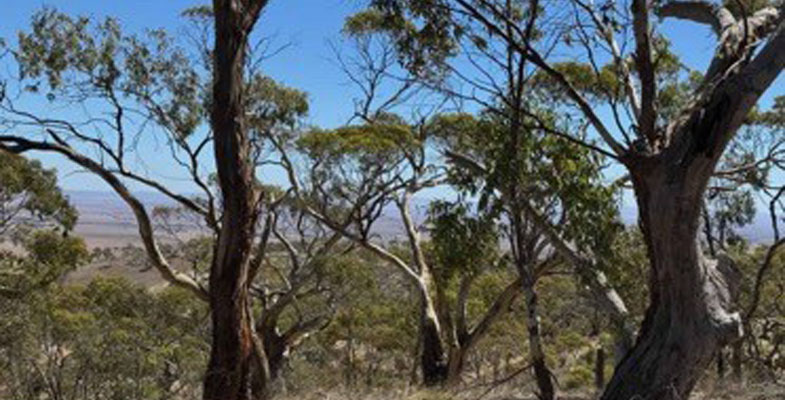
But what’s this about bushland? Clare Valley? You’re surely joking, that’s mostly vineyards isn't it? But west of Skillogalee and Kilikanoon wineries you rise up through the dry woodland and forest of Spring Gully Conservation Park, a significant-sized natural area of around 500 hectares and rising to 570 metres asl. Its woodland and forest are quite varied, but when you drive up to the western edge at Blue Gum Lookout it becomes increasingly stark. The lookout is named after Eucalyptus leucoxylon, a common smooth-barked tree over wide areas of SA, and is featured in the picture at the top of the page. It’s doing OK, but its main companion, red stringybark E. macrorhyncha, is in dire straits as shown in the picture below.
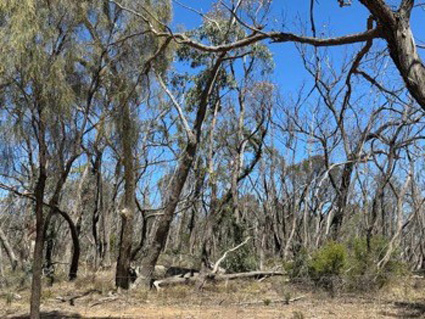
Red stringybark is widespread and common in hilly country throughout inland NSW, Victoria and the ACT, but the small population south-west of Clare is isolated and disjunct by hundreds of kilometres from its nearest sisters in Victoria. Elevation meant survival at Spring Gully, and was once its saving grace, but that’s no longer the case. There’s every chance climate change will wipe out most of its trees with only a few surviving in sheltered valleys.
By John Martyn